 |
 |
|
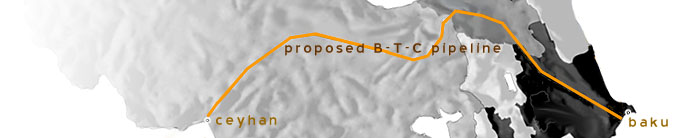
More information BP (along with other oil companies) is currently building a new pipeline system that was due to be completed in the latter half of 2005 but is now scheduled for mid-2006. It runs from the offshore oil fields of Azerbaijan in the Caspian Sea, to the southern shores of Turkey on the Mediterranean via Georgia. Starting near Baku in Azerbaijan, running close to Tbilisi in Georgia, and finishing south of Ceyhan in Turkey, it is known as the Baku-Tbilisi-Ceyhan (BTC) pipeline. [more info on what is planned] The project
is subsidised by British public money, through the Export
Credit Guarantee Department and other financial institutions. [more
info on financial institutions] Contracts already signed between BP and the three host governments have been described as 'colonial', as they bypass social, environmental and other domestic legislation, giving effective sovereignty to BP and its partners. [more info on colonialism] The pipeline passes through or
near seven different conflict zones. It will lead to the creation
of a 1,000-mile militarised corridor through three countries that
are known for their poor human rights record. [more
info on human rights and conflict All this is especially troubling given BP’s appalling environmental and human rights record in other pipeline systems it has already built – such as those in Colombia, Alaska and the North Sea [more info on BP’s record] BTC has been built by many actors and institutions - a consortium of oil companies supporting project operator BP, outsourcing particular tasks to contractors and financed by various public and private financial institutions. Map of the project - JPG format 336K
Official project documents:
|
|||||||||||||||