 |
 |
|
Colonialism and the Baku-Tbilisi-Ceyhan pipeline
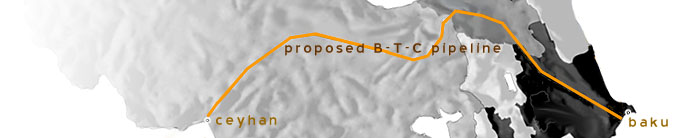
In the case of Turkey, the country would be effectively divided into three: the area where Turkish law applies; the Kurdish areas under official or de facto military rule; and a strip running the entire length of the country from North to South, where BP is the effective government. The only laws not trumped by the Host Government and Inter-Governmental Agreements are the three countries’ constitutions. And it seems even the constitutions are not safe from interference. There are some reports that BP is now lobbying the Georgian government to re-write sections of its constitution, so as to make it easier for BP to appropriate people’s land along the route. Although the HGAs differ from country to country, they share a number of common elements. These are exemplified by the Turkish HGA, which:
Other provisions in the HGA include unfettered access to water, regardless of the needs of local communities, and exemption from liability in the event of an oil spill or any other harm caused by the pipeline consortium. The Turkish government can intervene only in the case of an "imminent" and "material" threat to the public, the environment or national security. The preservation of the stability of the project prevails over any other considerations. Thus the project has power over the state in the relevant area. It is unclear as to what would be allowed as constituting an "imminent and material threat" and who would decide if such a threat existed. The high threshold of damage required before action is taken is at odds with any recognised concept of precaution in matters of environmental protection. Local populations would have no redress where the Government has not acted or has failed to act to protect its interests. The HGA also paves the way for the consortium building the pipeline to demand unlimited protection from Turkish security forces, without safeguards against human rights abuses. Under the vague wording of the agreement, paramilitary units could be placed along the pipeline route to pre-empt "civil disturbance" or "terrorist" activities. Since the pipeline cuts repeatedly through villages and bisects established ownership patterns, people could find themselves cut off from their families or land and be forced to trespass regularly on oil company property in their daily lives. The Kurdish Human Rights Project points out that Turkey "has recently charged students signing a Kurdish education petition with membership of an illegal terrorist organisation, and charged a father who named his daughter after a Kurdish character in a popular soap with sabotage of the state. These precedents do not instil confidence in the way such nebulous terms as 'civil disturbance' and 'terrorism' will be applied under this agreement." The HGA specifies that any arbitration proceeding shall be carried out in the English language. This exclusion of any other language places the Turkish Government and any other non-English speaking parties at a disadvantage. While supposedly, the agreements are meant to clarify the requirements on both sides, and indeed BP often suggests that they are as much to regulate BP as to regulate the government, the protections for Turkey and its citizens are extremely limited. The only specific reference in the HGA to compensation is to compensation to the consortium. Compensation to the state or to third parties is not specifically provided for. The consortium is to be liable to third parties only in those instances where it is in ‘breach of the standards of conduct set forth in the Project Agreement’. Those standards consist of, and are explicitly limited to those which are "generally prevailing in the international Petroleum pipeline industry for comparable projects." In a meeting with NGOs, BP was unable to specify any of the social or environmental standards to which this phrase referred. Similar provisions apply to the Azerbaijan and Georgia agreements. Even protections which are specified in the agreements, BP is now trying to undermine. For example, in Georgia the Host Government Agreement provides for a project environmental impact assessment to be subject to approval by the government. But in late 2002, as the Georgian government considered the impact of the pipeline on the Borjomi mineral water springs which produce the country’s largest export, and whether the route should be changed to protect the springs, BP placed heavy pressure on the government to approve the ESIA immediately, regardless of Georgia’s concerns. This intervention makes a mockery of the purpose of the EIA, namely to identify problems and agree mitigatory measures prior to the EIA being approved.
The Host Government Agreement signed by BTC and the Government of Turkey has many of the provisions of the now-discredited Multilateral Agreement on Investments (MAI). Negotiated in secret within the Organisation for Economic Cooperation and Development — a grouping of the world’s 29 richest countries, including Turkey [1] — the MAI was roundly rejected by national parliaments and the public after its contents were leaked to non-governmental organisations and broadcast on the internet. Branded a "corporate charter" by its critics, due to concerns over its social and environmental implications, the MAI provoked demonstrations on the streets of several OECD capitals. Opponents ranged from environment and development NGOs to consumer groups, human rights bodies, trade unions, local governments, parliamentarians and church groups. The MAI negotiations, initiated in 1995, finally fell apart in 1998. The MAI agreement would have empowered private investors to extract compensation from foreign governments for legislation that adversely affected their investments, regardless of the public interest. The HGA’s provisions on Turkey having to compensate BTC if any new social or environmental laws affect the "economic equilibrium" of the BTC pipeline reflect these MAI provisions. The MAI was also criticised for protecting the interests of the investor without any corresponding attention being paid to establishing legally-binding investor obligations and accountability. Its proposed "investor-state" dispute mechanism, involving secret tribunals, was also seen as biased in favour of companies and lacking in mechanisms which would give effective legal standing for citizens to bring actions. Again, the HGA can be criticised on both counts.
More info
Links
|
|||||||||||||||||