 |
 |
|
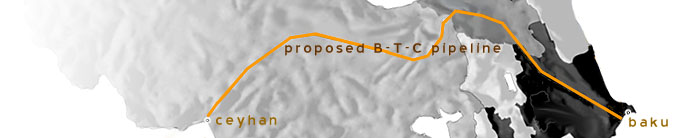
Environmental risks in the BTC pipelines system One of the arguments advanced in favour of the Baku-Tbilisi-Ceyhan (BTC) pipeline is that by going to the Mediterranean shores of Turkey, it would reduce tanker traffic through the Straits of the Bosphorus – an overcrowded seaway running right through Istanbul – and thus the likelihood of an environmental disaster there. In fact, the BTC pipeline will not reduce Bosphorus tanker traffic at all. Tankers will still depart from Supsa and Novorossiysk, carrying oil through the Bosphorus - much of that oil from BP's Caspian fields. What BP is actually offering to do is not to decrease Bosphorus traffic, but to refrain from INCREASING it. BP wants to extract MORE oil from the Caspian, and is offering to build BTC so as not to put this EXTRA oil through the Bosphorus.
The Environmental Impact Assessment for the BTC pipeline considers the risk of a spill in the Gulf of Iskenderun. Research by the Corner House has found that the Environmental Impact Assessment diverges from European standards on nine of counts: Summary of BTC breaches of EU Directive on Environmental Impact Assessments
Learning from experience The experience of the ‘Early Oil’ project – in which a small quantity of oil has been extracted since 1998, and piped to Supsa and Novorossiysk on the Black Sea coast, in advance of the full field development that will feed the BTC pipeline – gives some cause for concern. Officials of the Supsa port authority are also worried that they are not being allowed to check tankers in accordance with international conventions, even though the port carries responsibility for spill prevention and contingency plans. As a result, the risk of an accident can only be increased. BP supported the argument of shipping companies at Supsa that they should be exempt from regulation. Will it be the same at Yumurtalik? Furthermore, the standards of the Supsa oil terminal do not meet guidelines for special zones under the 1973-78 MARPOL Convention for the Prevention of Pollution from Ships, which require oil terminals to be equipped with adequate reception and wastewater facilities. It is also helpful to look further back, at the Trans-Alaska Pipeline System, which was built in the mid-1970s by Alyeska, a consortium led by BP. It was after loading at the Alyeska-run terminal at the southern end of that system that in March 1989, the Exxon Valdez oil tanker ran aground in Prince William Sound spilling 258,000 barrels of crude oil and creating one of the world's most worst environmental disasters. The TAPS pipeline was on paper one of the safest ever built. After sustained public challenges against the project, the final design of TAPS was technically very sophisticated, leading to great confidence that it would be environmentally safe. Yet throughout its operation – and continuing today – the pipeline system has suffered a severely lax attitude to safety standards combined with hostility to regulation and harassment of workers and others who have attempted to raise concerns about the safety problems. (See chapter 12 of Some Common Concerns) Against this background, it is not reassuring that the same promise made in BP’s consultation leaflet on BTC, distributed in Azerbaijan, that the pipeline "will be built to the highest international standards" was also made by Alyeska in 1976: "this pipeline is being built to conform to the highest standards for quality and safety, thus ensuring both its environmental and operational integrity". Part of the reason the Exxon Valdez spill became a major environmental disaster was that responsibility was not clearly defined. The Alyeska consortium, which operated the Valdez terminal, had statutory responsibility, and had developed a contingency plan along with regulators, but hours after the grounding handed over responsibility to the ship-owner, Exxon. The companies later shifted responsibility again, publicly blaming the captain of the tanker. In the case of the Turkey section of the BTC pipeline system, including the Ceyhan / Yumurtalik terminal, there is an added complication in the assignment of responsibility, as the pipeline would be operated by Turkish pipeline company Botaş, through a turnkey agreement. While the patterns of corporate behaviour were clearly culpable in the Exxon Valdez disaster, it was also a failure of the regulatory system. But what would happen in BTC’s case, where the national regulatory systems are of weaker status than the oil companies’ contracts? According to the BTC pipeline Host Government Agreement between Turkey and the oil companies, for example, no new environmental law or measure can be introduced which exceeds international norms for oil industry pipelines. Furthermore, the Turkish state does not have the right to stop the flow of oil, except where there is an immediate and serious emergency. Risks from earthquakes Turkey lies in a major earthquake zone, and one of the most serious fault lines in Turkey runs directly from Sivas through Erzincan to Erzurum: exactly the intended route of the Baku-Tbilisi-Ceyhan pipeline. At a conservative estimate (looking just at areas that are right on the route and ignoring the very frequent earthquakes in places like Varto, Bingöl and Muş which are close enough to cause serious damage), there have been at least 17 major earthquakes since 1924, measuring from 5.5 to 7.9 on the Richter scale, directly along the pipeline route. Erzincan has been completely destroyed and rebuilt on two separate occasions: after the 1939 earthquake which measured 7.9 and killed almost 33,000 people, and again more recently in 1992 after a 6.8 earthquake killed 653. In 1983, Erzurum was hit by a 6.9 earthquake, which killed nearly 1,200 people. The entire region is permanently under duress: in the first seven months of 2002, there were no fewer than 44 minor earthquakes (all under 4.5 on the Richter Scale), in various locations along the pipeline route.
Links
|
|||||||||||||||||||||