 |
 |
|
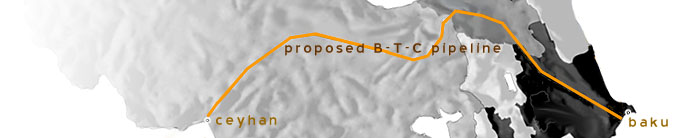
Conflict, militarisation, human rights and the Baku-Tbilisi-Ceyhan pipeline What is the risk of the Baku-Tbilisi-Ceyhan pipeline causing greater conflict and bloodshed? Given that the planned pipeline route passes through or near seven different war-zones, will BP find itself at some point in the next 40 years caught up in a conflict, a conflict inflamed by its own activities? Will the state-led militarisation, which would be imposed to secure the pipelines system, contribute in the long-term to political instability, and diminish regional security? Will BP become associated with human rights violations carried out by its associates and allies to protect the pipelines system? (Much of the material on this page is drawn from ‘Caspian oil on the east-west crossroad’, by Saulius Piksrys, CEE Bankwatch network, Lithuania, December 2001 See also the Baku Ceyhan Campaign’s book, ‘Some Common Concerns’ Militarisation in the Caspian region in the 1990s The BTC pipeline would pass just 10 miles from Nagorno-Karabakh, the area of Azerbaijan occupied by Armenia, where a bloody conflict killed at least 25,000 people and created at least a million refugees.
Due to the unresolved conflict with Armenia, Azerbaijan still keeps strong armed forces, consuming an important share of its budget. Chinese and Russian support of Armenia has led Azerbaijan to seek military co-operation with the West and Islamic countries. Since regaining its independence in 1990 from the Soviet Union, Georgia has been only partially successful in establishing an effective military force under the control of the government. Most of its armed units have been drawn from formerly independent militias and guerrilla groups, whose loyalty to local commanders still supersedes the troops' allegiance to the Georgian government. Non-payment of salaries, high desertion rates, and criminal actions plague the military's development. Georgia’s security is threatened by its location just south of the strife-torn Russian republics, including Chechnya, Dagestan and Ingushetia, and also from within by an conflict with the separatist regions of Abkhazia and South Ossetia, where Russian influence recently strengthened. Turkey has a substantial military capacity, military expenditure accounting for an enormous 5.6 per cent of GDP. Many soldiers are deployed in Kurdish regions. As recently as May 2002, Turkish security forces, backed by warplanes and attack helicopters, attacked the Kurdish Tunceli region, which the planned BTC pipeline would skirt. From 1987 until summer 2002, Tunceli remained under State of Emergency rule, which allowed regional governors to exercise quasi-martial law powers. Russia and the Western powers have been growing increasingly competitive in the south Caucasus region in the 1990s, but Azerbaijan and Georgia have resisted Russian attempts to bring them more closely into security arrangements of the Community of Independent States. After the collapse of the Soviet Union, Azerbaijan and Georgia became members of the NATO-led ‘Partnership for Peace’ initiative, and have also integrated into the Georgia, Ukraine, Uzbekistan, Azerbaijan, Moldova regional co-operation group, known as GUUAM. Turkey remains a key NATO member and a strategic US ally; its airbases (including Incirlik, near the end of the BTC oil pipeline – see chapter 3) are used by the US for bombing raids against Iraq, and more recently Afghanistan. Since 11th September 2001, Georgia and Azerbaijan have significantly increased their cooperation with the USA. Both countries immediately provided the USA with rights to fly over their territories for military operations. In March 2002, the US Defense Department pledged US$ 4.4 million in military aid to Azerbaijan with the reported aims of countering terrorism, promoting stability in the Caucasus, and developing trade and transport corridors. But the most important US military interest in the region is in Georgia. In February 2002, the US government said it would provide Georgia with military support worth US$ 64 million, and promised to dispatch 180 crack troops and to train up to 2,000 Georgians in anti-terrorism and counter-insurgency operations, chiefly in the Pankisi Gorge, where Al Qaeda fighters (as well as Chechens) are believed to have taken refuge. The pipeline route would pass about 100 kilometres away from the Pankisi Gorge area. Strong cultural and political links exist between Turkey and Azerbaijan. Turkish officers have served as advisers to the Azerbaijani armed forces, and Turkey will reportedly modernise Azerbaijan's armed forces within the framework of a new programme named ‘Arms in Exchange for Gas’. Given the planned volumes of shipments of Azerbaijani gas to Turkey, Baku could receive arms and military equipment to the value of up to US$ 60 million over the next five years. Shipments would then progressively increase after 2007 and could exceed $150-170 million. In the last few months, Azerbaijan and Georgia have signed an anti-terrorist agreement with Turkey. Bilateral cooperation details will be worked on by a working commission to be set up no later than July 2002. The Georgian Defence Minister also indicated that Georgia is interested in sending officers to study in military schools in Azerbaijan. Pipelines exacerbate tension In developing countries, the construction and operation of pipelines have often triggered further tensions, militarisation and conflicts on a local scale. Because of the international nature of the Baku-Tbilisi-Ceyhan project, potential conflicts might develop also on a regional scale, thus undermining the already weak stability of the region. There is already evidence that some groups may be disposed to sabotage the pipelines system. If these fears are realised, the human toll could be devastating. For example, upon returning to Baku from internal exile in 1997, ex-President and Azerbaijan Popular Front (AzPF) Chairman Abulfaz Elchibey warned that AzPF partisans in the Gazakh and Agstafa regions might take military action against the Baku-Supsa pipeline if the project did not "serve the interests of the Azerbaijani people". In Turkey, the PKK has had a history of targeting oil installations. During the height of their armed conflict with Turkish security forces in the 1990s, the PKK identified Turkish pipelines and oil refineries in the Kurdish regions as legitimate military targets. In July 1991, PKK guerillas raided Turkish Petroleum’s (TPAO’s) research camp in Kurtalan and blew up 15 vehicles. Five months later in December 1991, the PKK destroyed TPAO’s Selmo oil wells near the city of Batman with rocket fires. Then, in less than five weeks between 31 August and 5 October 1992, the PKK attacked three different pipeline sites in the Kurdish regions. First, on 31 August, Shell Oil’s depots near the Kurdish stronghold of Diyarbakir, were attacked and oil tanks were once again set on fire. Less than two weeks later, on 12 September, the PKK raided the Selmo oilfields a second time, setting fires and killing three engineers. Then, at the beginning of October, the TPAO pumping stations and factories near Sason were attacked and set on fire. In one of its most serious pipeline attacks on 10 July 1996, the PKK set fire to part of the Kirkuk-Yumurtalik pipeline (Turkey-Iraq) in Silopi, Iraq. These fires could not be controlled for days. Six months later, in January 1997, the PKK attacked Kirkuk-Yumurtalik again, this time in the town of Mardin in south-eastern Turkey. The BTC pipeline would pass directly through areas around Erzurum where the PKK has been very active. In Azerbaijan and Georgia the BTC pipeline would pass close to Nagorno-Karabakh (15 kilometres), Abkhazia (130 kilometres) and South Ossetia (55 kilometres), all of whom might consider themselves enemies, respectively of Azerbaijan or Georgia: even if not now, then quite possibly at some point within the next 40 years (the planned lifetime of the BTC pipeline). Pipeline militarisation Meanwhile, there are clear indications of the host states’ plans to militarise the region of the pipelines system, which would carry grave risks for stability in the region and for human rights. Since 1999, Georgia has already lined the Baku-Supsa pipeline with military posts and has been conducting joint military exercises with Azerbaijan to promote pipeline security. Conspicuously, Georgian President Shevardnadze has also remarked publicly on several recent occasions that Georgia intends to join NATO, and this decision is motivated at least in part by a desire to cast itself as a long-term, stable oil partner. On 3rd July 2001, BP Vice President John Sullivan and Georgian President Eduard Shevardnadze discussed security for the construction and operation of the BTC oil and SCP gas pipelines. At the meeting, they agreed to set up an inter-departmental commission with the participation of law enforcement structures, which would guarantee the security of the construction and operation of the oil and gas pipelines. A few days before this meeting, President Shevardnadze had publicly announced that the Georgian State Guard Service would be responsible for the security of the transportation of Caspian oil and gas resources through Georgia. He also revealed that a special unit of the service had been policing the Baku-Supsa oil pipeline for the past two years. As the region has recently become further militarised following September 11th 2001, US-led anti-terrorism initiatives have been directly linked to the need to increase security along the east-west energy corridor. In April 2002, Azerbaijan and Georgia signed a new military agreement designed to increase oil and gas pipeline security, alongside anti-terrorist and anti-separatism efforts. At the end of the meeting, the Vice President of the Azerbaijani state-owned oil company SOCAR, Ilham Aliyev (who is the son of Azerbaijani President Aliyev), publicly admitted that the protection of the BTC pipeline would involve the United States as well as Azerbaijan, Turkey and Georgia. Following increasing US deployment in Georgia in 2002, a BP spokeswoman commented, "The pipelines will of course benefit from the military presence". The potential creation of a ‘militarised corridor’ along the pipelines’ route in Turkey’s Kurdish regions poses the serious threat of an escalation in State violence in these war-ravaged regions. Responsibility for the security of the pipeline in Turkey would rest with the Turkish State Gendarmérie. Considering Turkey’s continued failure to commit to serious human rights reform – most particularly, the on-going impunity of those responsible for torture in custody and extra-judicial killing – the increased militarisation that would potentially accompany the development of the AGT pipelines could also bring with it a massive blow to the cause of peace in Turkey. The PKK has maintained a three-year cease-fire, but it is a delicate one that would not be aided by an increased military presence in the Kurdish areas, where people continue to suffer gross human rights violations at the hands of the State. Significantly, the Council of Europe passed a highly critical resolution in July 2002, condemning the severe and ongoing human rights abuses committed by Turkish security forces and naming the Gendarméries as one of the forces in urgent need of reform. Human Rights: Turkey and the Kurds Although the BTC pipeline would not pass through the predominantly Kurdish regions of south-eastern Turkey, it would pass through areas of north-eastern Turkey where Kurds make up around 40 per cent of the population. In these areas, the Turkish State has committed gross human rights abuses, violently suppressing free expression, and harassing and imprisoning democratically-elected Kurdish officials and supporters of legally-registered, pro-Kurdish political parties. Kurds in Turkey have for decades been subjected to gross human rights violations and economic disadvantages. They bear the hallmarks of systematic persecution from a State intent on destroying the Kurdish identity by silencing the Kurdish language and other cultural expressions through violence or censorship. Since the foundation of the Turkish State in 1923 under the leadership of Mustafa Kemal Atatürk, Turkey has refused to recognise the existence of a separate Kurdish ethnic community within its borders. Officially, under the 1923 Treaty of Lausanne, all inhabitants of Turkey were defined as "Turkish": to define oneself as belonging to any other ethnic group was regarded as an act of defiance against State authority. In 1924, an official decree banned all Kurdish schools, organisations and publications. Use of the words "Kurd" and "Kurdistan" was forbidden and references to them were removed from Turkish history books. Over the course of the next decade, the newly established State used brutal methods, including mass deportations, in an attempt to pacify the rebellious Kurdish south-east of the country and to try to assimilate the Kurds into the Turkish population forcibly. In June 1934, Law 2510 divided Turkey into three zones: (i) localities to be reserved for the habitation of persons possessing Turkish culture; (ii) areas to which persons of non-Turkish culture could be moved for assimilation into Turkish culture; and (iii) regions for complete evacuation. At that stage, almost all Kurdish villages were renamed with Turkish-sounding names. Parents could not register their children with distinctively Kurdish names. The Kurdish language was forbidden in written and spoken form. Kurdish folklore, music, clothes and colours, and the celebration of the Kurdish new year festival, Newroz, have all been banned at various times. Today, more than 15 million Kurds live in Turkey, are still denied basic human and cultural rights, and face the continuing horrors of forced assimilation, involuntary displacement, repression and human rights abuses. Beyond regular reports of the United Nations, the Council of Europe, the US State Department’s Bureau of Human Rights, and the Organisation for Security and Cooperation in Europe, Turkey’s abysmal human rights record has been well-documented by more than 300 judgments involving Turkey which have been handed down by the European Court of Human Rights. Turkey’s record at the European Court reveals it to be by far the Court’s worst offender in cases that involve the most serious of human rights abuses including extra-judicial killing, ‘disappearances’ and torture in custody. Against this background of conflict and human rights abuses, we must ask whether the passage of $21 million worth of resources through the region every day will help or hinder the cause of peace. Links on conflict in the Caucasus BBC News – Caucasus profile CEE Bankwatch Network - ‘Caspian oil on the east-west crossroad’: paper on militarisation Conciliation Resources – Caucasus programme FEWER - Caucasus programme Prof Mary Kaldor, London School of Economics – expert on Caucasus, oil and conflict Links on human rights in the Caucasus and Turkey Amnesty International – Azerbaijan Amnesty International – Georgia Amnesty International – Turkey Human Rights Watch – Azerbaijan IHD (Human Rights Association of Turkey) |
|||||||||||||||||||